Physics 207 - Buoyancy Tutorial
Exercise 1
A rectangular container filled with water is at rest on a table as shown below. Two imaginary boundaries that divide the water into 3 layers of equal volume have been drawn in the diagram. (No material barrier separates the layers.) Assume water is incompressible

For each layer on a separate sheet of paper, draw a rectangle representing each layer. On each rectangle draw a free body diagram of that layer. Indicate on your diagram the surface on which each contact force is applied by placing the tip of the arrow that represents the force at that surface
The label for each force should indicate:
- The type of force
- The object on which the force is exerted
- The object exerting the force
In the box below, rank the magnitudes of all the vertical forces you have drawn in the 3 diagrams from largest to smallest. Explain your reasoning.
Imagine a small hole is opened in the container wall near the bottom of each layer. Predict what will happen.
Check your prediction by observing the demonstration.
What do your observations suggest about (1) the existence of horizontal forces on the three layers of water? (2) the relative magnitudes of the horizontal forces on the three layers?
If necessary, revise your free body diagrams above so that they are consistent with your answers.
The relationship between force and pressure is expressed by $P=F/A$.
Which force from your free body diagrams would you use to determine the pressure at the bottom of layer 2?
Which area would you use to determine the pressure at the bottom of layer 2?
Suppose that you wanted to determine the pressure at a point in the center of layer 2. For what object would you draw a free body diagram? Which force and which area would you use?
Suppose that you wanted to determine the pressure at the top surface of layer 1. Which force and which area would you use?
Three points, L, M, and N, are marked at the bottom of each of the 3 layers. Rank the pressures at these 3 points and explain how your answer is consistent with your ranking of forces in your free body diagrams.

The pressure P at a point in an incompressible liquid is often described mathematically as $P = P_0 + \rho gh$. Is your ranking of pressures consistent with this equation?
Exercise 2
A cubical block is observed to float in a bucket of water. The block is then held near the center of the bucket as shown and released.
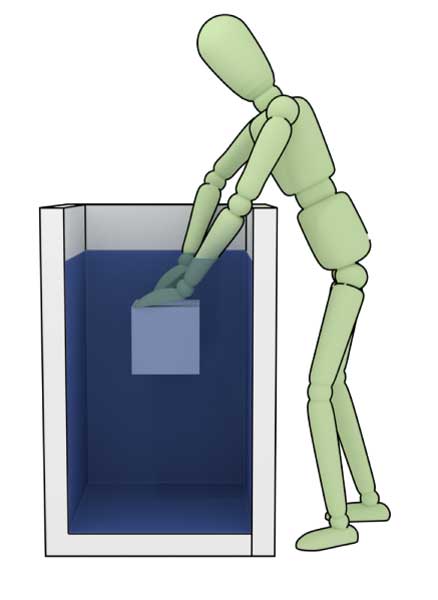
Describe the motion of the block after it is released.
On a separate sheet of paper, draw a free body diagram for the block at the instant it is released. Show the forces that the water exerts on each of the surfaces of the block separately.
In the box below, rank the magnitudes of all the vertical forces you have drawn. If it is not possible to completely rank the forces state so explicitly. Explain your reasoning.
Verify that the vector sum of the forces is consistent with Newton’s second law.
Exercise 3
The experiment in exercise 2 is repeated with a second block that has the same volume and shape as the previous block. However this block is observed to sink in the bucket of water.
On a separate sheet of paper, in the same way as in exercise 2, draw a free body diagram for this block at the instant it is released.
Compare the free body diagram for the block that sinks to the one you drew in exercise 2 for the block that floats. Which forces are the same in magnitude and which are different? (Hint: How does the pressure at each surface of the blocks compare?)
In the box below, rank the magnitudes of all the vertical forces you have drawn. If it is not possible to completely rank the forces state so explicitly. Explain your reasoning.
Verify that the vector sum of the forces is consistent with Newton’s second law.
Imagine that you were to release the block at a much greater depth. State whether each of the forces on the block would be greater than, less than, or equal to the corresponding force on the block released at the original depth.
When you release the block at a much greater depth, is the vector sum of the forces on the block by the surrounding water greater than, less than, or equal to the corresponding vector sum of the forces on the block released at the original depth. (Hint: Does the difference between the pressures at the top and bottom surfaces of the block change?)
The vector sum of the forces exerted on an object by a surrounding liquid is called the buoyant force. This is customarily represented by a single arrow on a free body diagram.
Exercise 4
Archimedes’ principle states that the magnitude of the buoyant force exerted on an object by a liquid is equal to the weight of the volume of that liquid displaced by the object. Use a free body diagram of a cubical block whose top is submerged a distance d to show that Archimedes’ principle applies. (Hint, use $P = P_0 + \rho gh$ to find the difference in forces at the top and bottom of the cube.)
Exercise 5
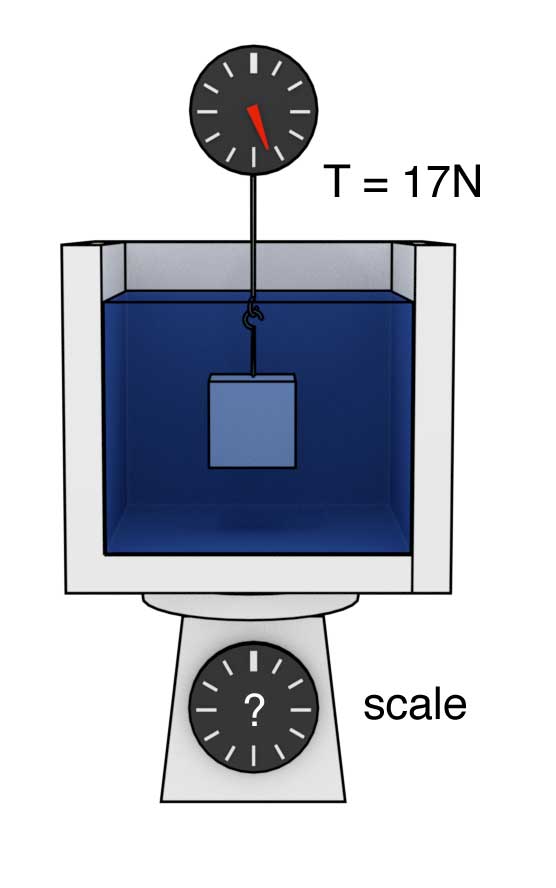
A cubical block weighs 25 N. It appears to weigh 17 N when immersed in water (and suspended from a spring scale - see diagram) and 20 N when immersed in another liquid of unknown density. (Density of water = 1000 kg/m3.)

Find the volume of the object
Find the density of the unknown liquid.
Before you submerge the object in water, you place the container of water on a scale. The scale reads 200 N. When you immerse the object in water, what is the reading on the scale? (Assume that the object does not touch the sides or bottom of the container at all.) Explain your reasoning.
The materials are based on activities from Tutorials in introductory physics, L.C. McDermott, P.S. Shaffer, and the Physics Education Group at the University of Washington (Prentice Hall, Upper Saddle River NJ, 1998).